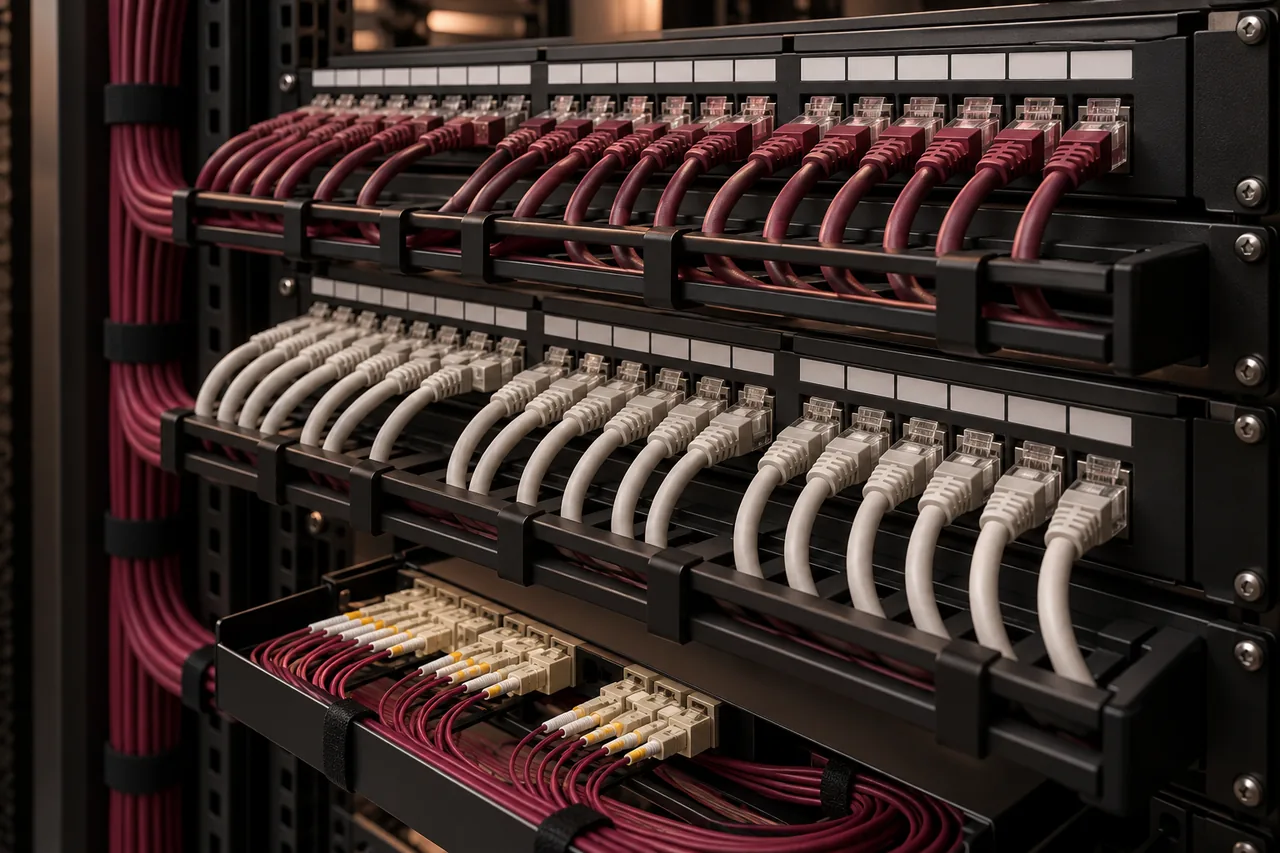
Structured cabling cost in Saudi Arabia depends on the installation scope, not simply the number of desks. Cable category, route length, containment, rack equipment, working conditions and testing all affect the quotation. There is no responsible universal price for an unspecified office. The useful first step is to define what will be installed, where it will run and how completion will be accepted.
For a procurement team, the goal is a comparable quotation rather than the lowest-looking total. One proposal may include certified link testing and as-built documentation while another includes only termination. Understanding those differences helps you budget for a network that works at handover and remains maintainable afterwards.
Start with the number and purpose of outlets
Count the devices that need physical connections: workstations, access points, printers, IP phones, cameras and building systems. A desk may need more than one outlet, while a ceiling access point requires a different cable route and mounting arrangement. Include shared areas, meeting rooms and planned expansion instead of estimating only from current employee headcount.
Record outlet positions on a floor plan and give each a reference. This allows installers to calculate realistic cable lengths and identify difficult routes. For a phased fit-out, distinguish outlets required at opening from future locations. Installing containment now may be sensible even when some cable runs will be added later.
Cable category changes more than material cost
Cat6 and Cat6A differ in supported applications and installation requirements. Cat6A is designed for 10GBASE-T over a standard 100-metre channel, but its larger cable size can affect tray capacity, bends and rack management. Cat6 may be appropriate for gigabit office connections, depending on the complete design. Read our Cat6 versus Cat6A guide before specifying a category purely by price.
Fiber is often evaluated for backbone links, longer distances or connections between communications rooms. Fiber cost includes more than the cable: distribution panels, connectors, termination, testing and compatible transceivers must be considered. Ask the designer to explain the intended application and the interfaces at both ends of every backbone.
Pathways and building conditions influence labor
An accessible ceiling route in an unfinished office is a different job from concealed cabling in an occupied building. Existing trays, trunking, conduits and risers can reduce work if they are suitable and have available capacity. New containment, drilling, wall outlets, difficult access and reinstatement can change the budget substantially.
Saudi commercial projects can involve multiple stakeholders: landlord, fit-out contractor, facilities team and IT provider. Confirm who approves access and who owns each pathway. Outdoor routes and industrial environments also need suitable protection against the actual conditions. Do not assume an indoor cable specification is appropriate for every location simply because it connects the same kind of device.
Price the rack as part of the system
A rack allowance should identify size, patch panels, cable managers, shelves and any included accessories. Switches, firewalls, UPS equipment and active fiber components may be separate packages. Clarify those boundaries so missing items do not become late changes when the office is nearly ready.
Check usable space rather than only the rack’s advertised height. Equipment depth, ventilation, service access and cable entry matter. A compact cabinet can be unsuitable for a server or crowded PoE switch stack. Discuss the number of installed and spare ports, and leave an agreed amount of capacity for expansion.
Testing and documentation are budget items
Continuity testing tells you that conductors connect, but it does not prove every performance characteristic of a cable category. Qualification and certification serve different purposes. The RFQ should specify the required test method and acceptance criteria, along with the format of reports. Do not accept the word “tested” as a complete deliverable.
Labeling and records are equally practical. Ask for a consistent outlet-to-panel naming scheme, an as-built outlet plan and a link schedule. Our cabling project checklist explains how to include these in acceptance. Good records reduce tracing work when an employee moves, a camera fails or another contractor takes over support.
Compare proposals on the same assumptions
Make a simple comparison sheet rather than judging quotations from their totals alone. Align quantities, category, brands where specified, test requirements and exclusions. A lower rate may be reasonable, but it may also reflect shorter route assumptions or omitted containment. Ask suppliers to identify assumptions explicitly.
- Cable and outlet quantities, with route-length assumptions.
- Included containment, termination and rack accessories.
- Active equipment and licenses included or excluded.
- Work hours, access equipment and occupied-site restrictions.
- Testing method, labeling and documentation deliverables.
- Payment, warranty, variation and handover terms.
Check the tax treatment and commercial validity stated on each proposal rather than assuming all totals are directly comparable. Keep any contingency tied to identified uncertainties, such as inaccessible routes or an incomplete floor plan. A site survey can resolve some uncertainties before procurement instead of leaving them to be priced during installation.
Give suppliers enough information to quote
A useful RFQ contains the address, drawings, outlet schedule, expected network applications, preferred category and target handover date. Include photos of existing racks and pathways if available. State whether this is a new fit-out, a relocation or an occupied-site upgrade, and explain any working-hour restrictions.
If drawings are incomplete, say which quantities are provisional and request a survey-based scope. FusionCore’s structured cabling service can be discussed as a standalone package or coordinated with networking. Keep responsibilities for power, containment and active equipment clear across contractors.
Conclusion: buy a defined outcome
The best cabling budget describes a tested, labeled and documented installation, not just a length of cable. Define outlets and routes first, select a category for the application, and compare every quotation against the same acceptance requirements. That approach helps control variations and gives your team a reliable physical network foundation. Send FusionCore your BOQ or project requirement through the quotation page to discuss the next step.
Frequently asked questions
A few practical questions.
Can I get a price per network point?
A unit rate can be useful only after defining what a point includes: cable length assumptions, outlets, termination, containment, testing and access. Separate unusual routes and shared rack costs.
Can existing cabling be reused?
Potentially. Its category, condition, route, identifiers and test results need review. Reuse should depend on the required application and agreed acceptance checks.